
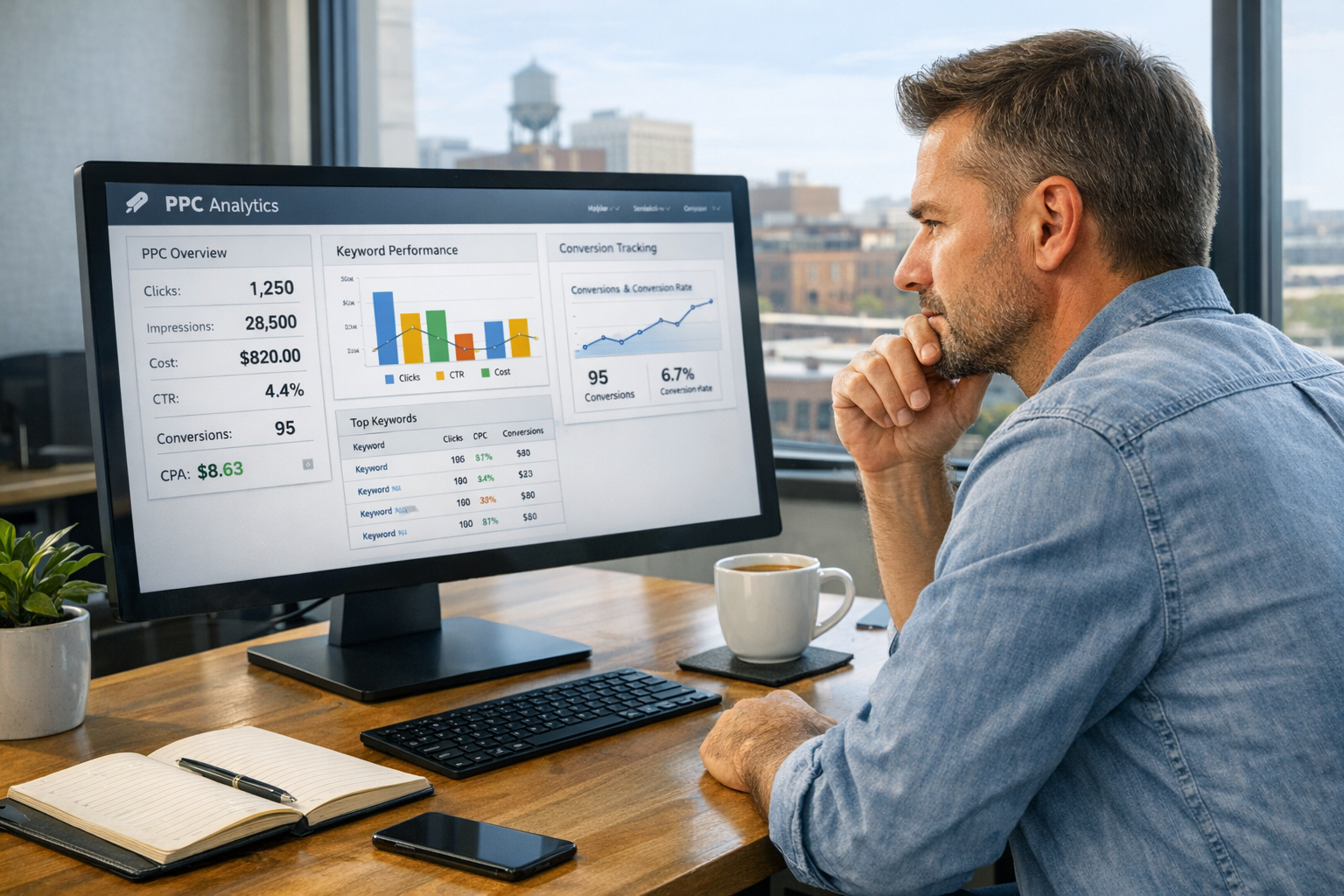
Why Most Small Businesses Burn Through Ad Budgets Without Results
We see it all the time here in Waco TX. A small business owner launches a Google Ads campaign, watches the clicks roll in, and then wonders why the phone never rings. The truth is that pay-per-click advertising is one of the most powerful tools in small business digital marketing, but only when it is built on a real strategy. Without the right structure, targeting, and tracking, every dollar you spend on online advertising is basically a donation to Google.
Our team at Sith Marketing has managed hundreds of PPC campaigns for local businesses, and we have learned one consistent lesson. PPC advertising for small businesses works incredibly well when the fundamentals are right. It fails spectacularly when they are not. The difference between a campaign that generates a strong return on investment (ROI) and one that drains your bank account usually comes down to a handful of avoidable mistakes.
So if you have tried pay-per-click (PPC) marketing before and felt like it was a money pit, you are not alone. But you are also not stuck. In this guide, we are going to walk through exactly how to build a PPC campaign strategy that actually delivers leads, sales, and measurable growth for your business right here in Waco TX.
Building a PPC Campaign Strategy That Actually Works for Small Businesses
The biggest mistake we see in PPC advertising for small businesses is jumping straight into Google Ads without a plan. Someone creates an account, picks a few keywords, writes a quick ad, and hits publish. That is not a strategy. That is a gamble.
Start With Clear Goals and a Realistic PPC Budget
Before you spend a single dollar on pay-per-click advertising, you need to define what success looks like. Are you trying to drive phone calls? Generate form submissions? Sell a product online? Each of these goals requires a different PPC campaign strategy, different ad formats, and different measurement tools.
Once your goals are clear, you need to set a PPC budget that matches the competitive landscape in your market. In Waco TX, the cost per click (CPC) for service-based keywords like “plumber near me” or “family dentist Waco” can range anywhere from three dollars to over fifteen dollars per click. If your daily budget is only ten dollars, you might get just one or two clicks per day. That is not enough data to optimize anything.
We recommend starting with a PPC budget that allows for at least fifteen to twenty clicks per day. That gives you enough volume to identify what is working and what needs to change. Here is a simple framework we use with our clients:
– Define one primary conversion goal such as a phone call, form fill, or purchase.
– Research the average cost per click (CPC) in your industry and location.
– Set a daily budget that allows for at least fifteen clicks.
– Commit to running the campaign for at least thirty days before making major changes.
– Track every conversion from day one using conversion tracking tools.
Choose the Right Keywords With Precision Targeting
Keyword targeting is the backbone of every successful Google Ads PPC campaign. Too many small businesses target broad, generic keywords that attract irrelevant traffic. If you run a roofing company in Waco TX, bidding on the keyword “roofing” without any geographic or intent modifiers is a recipe for wasted spend.
We focus on keyword targeting that matches buyer intent. That means using phrase match and exact match keywords that include location modifiers and action-oriented language. Think “roof repair Waco TX” instead of just “roofing.” This approach lowers your cost per click (CPC), improves your conversion rate, and ensures your ads reach people who are actually ready to hire or buy.
Negative keywords are equally important. These are the terms you tell Google not to show your ads for. If you are a premium service provider, you might add negative keywords like “cheap,” “free,” or “DIY.” This keeps your PPC budget focused on high-quality clicks that are more likely to convert.
Choosing the Right Platforms and Channels for Local PPC Advertising
When most people think of pay-per-click (PPC) marketing, they think of Google Ads. And for good reason. Google Ads PPC is the most widely used online advertising platform in the world, processing over 8.5 billion searches per day according to Internet Live Stats. But it is not the only option, and for some businesses, it might not even be the best starting point.
Google Ads PPC and Search Ads for Local Businesses
Google Ads PPC remains the gold standard for PPC advertising for small businesses, especially when it comes to search ads. Search ads appear at the top of Google search results when someone types in a query that matches your keyword targeting. This is the highest-intent traffic you can buy because the person is actively searching for what you offer.
For local PPC advertising in Waco TX, Google Ads offers powerful location targeting features. You can set your ads to only appear for people searching within a specific radius of your business. Combined with call extensions, location extensions, and a strong call to action (CTA), search ads can become a reliable lead generation machine for local businesses.
We typically recommend that PPC for local businesses in Waco start with search ads focused on high-intent, location-specific keywords. Once those campaigns are generating a positive return on ad spend (ROAS), you can expand into other formats.
Facebook Ads and Display Ads for Awareness and Remarketing
While Google Ads PPC captures people who are already searching, Facebook Ads and display ads help you reach people before they start searching. These platforms are excellent for building awareness, showcasing promotions, and staying top of mind with potential customers in your area.
Facebook Ads allow you to target users based on demographics, interests, behaviors, and location. For a small business in Waco TX, you can create campaigns targeting homeowners within a ten-mile radius who have shown interest in home improvement. This kind of precision targeting makes Facebook Ads a valuable complement to your search ads.
Display ads work similarly but appear across the Google Display Network, which includes millions of websites, apps, and YouTube videos. While display ads typically have a lower conversion rate than search ads, they are excellent for remarketing campaigns.
Remarketing campaigns show your ads to people who have already visited your website but did not convert. This is one of the most cost-effective forms of pay-per-click advertising because you are targeting warm leads who already know your brand. We have seen remarketing campaigns deliver a return on ad spend (ROAS) that is three to five times higher than standard display campaigns.
Our local marketing services at Sith Marketing include full setup and PPC management across Google Ads, Facebook Ads, and remarketing campaigns so that every channel works together as part of a unified PPC campaign strategy.
Optimizing for Conversions: Landing Pages, Ad Copy, and Testing
Getting clicks is only half the battle. If those clicks land on a confusing, slow, or irrelevant page, your conversion rate will tank and your money is wasted. This is where PPC management separates the amateurs from the professionals.
Landing Page Optimization That Turns Clicks Into Customers
Every PPC campaign should send traffic to a dedicated landing page, not your homepage. Landing pages are designed with a single purpose: to convert the visitor into a lead or customer. They should be clean, fast, mobile-friendly, and focused on one clear call to action (CTA).
Here is what we include on every landing page we build for PPC advertising for small businesses:
– A headline that matches the ad copy and the searcher’s intent.
– A clear and compelling call to action (CTA) above the fold.
– Social proof such as reviews, testimonials, or trust badges.
– A simple form or click-to-call button for easy conversion.
– Fast load times, ideally under three seconds on mobile.
Landing page optimization is not a one-and-done task. It is an ongoing process of testing, measuring, and improving. Even small changes to your headline, button color, or form length can have a significant impact on your conversion rate.
Writing Ad Copy That Connects and Converts
Your ad copy is the first impression someone has of your business. In Google Ads PPC, you have limited space to make your case, so every word matters. Great ad copy speaks directly to the searcher’s need, highlights what makes you different, and includes a strong call to action (CTA).
For PPC for local businesses in Waco, we always include location-specific language in our ad copy. Phrases like “Serving Waco TX families since 2010” or “Waco’s most trusted HVAC team” build immediate local credibility and improve click-through rates.
We also align the ad copy with the landing page content. If your ad promises a free estimate, the landing page better feature a free estimate form front and center. Consistency between your ad copy and your landing pages is critical for maintaining a strong conversion rate and a high quality score in Google Ads.
A/B Testing to Continuously Improve Performance
A/B testing is the process of running two versions of an ad or landing page simultaneously to see which one performs better. It is one of the most important practices in professional PPC management, and it is something we do continuously for every client.
You might test two different headlines, two different images, or two different calls to action. The key is to change only one variable at a time so you know exactly what caused the difference in performance. Over time, A/B testing compounds small improvements into dramatically better results.
We have seen A/B testing improve conversion rates by 20 to 40 percent for small business digital marketing campaigns. That means the same PPC budget generates significantly more leads without spending an extra dollar on online advertising.
Tracking, Analytics, and Measuring What Matters in PPC
If you are not tracking your results, you are not doing PPC management. You are just guessing. PPC tracking and analytics give you the data you need to make informed decisions about where to invest, what to cut, and how to improve.
Setting Up Conversion Tracking the Right Way
Conversion tracking tells you exactly which clicks turned into leads or sales. Without it, you have no way of knowing whether your PPC campaign is profitable. We set up conversion tracking for every action that matters: phone calls, form submissions, live chats, purchases, and appointment bookings.
Google Ads has built-in conversion tracking tools that connect with Google Analytics, Google Tag Manager, and your CRM. When configured correctly, you can trace every lead back to the exact keyword, ad, and campaign that generated it. This level of visibility is what makes pay-per-click (PPC) marketing so powerful compared to traditional advertising.
For local PPC advertising, we also track offline conversions whenever possible. If someone clicks your ad, visits your store, and makes a purchase in person, we want to capture that data. Accurate conversion tracking is the foundation of calculating your true return on investment (ROI) and return on ad spend (ROAS).
Using PPC Tracking and Analytics to Scale Profitably
Once conversion tracking is in place, PPC tracking and analytics become your roadmap for growth. We monitor key metrics including cost per click (CPC), conversion rate, cost per conversion, and return on ad spend (ROAS) on a weekly basis.
Here is how we use analytics to optimize PPC advertising for small businesses:
– Pause or adjust keywords with a high CPC and low conversion rate.
– Increase budget on campaigns delivering the best return on investment (ROI).
– Refine audience targeting based on demographic and geographic performance data.
– Update ad copy and landing pages based on A/B testing results.
– Expand into new keyword targeting opportunities as the campaign matures.
PPC tracking and analytics remove the guesswork from online advertising. They let you make decisions based on real numbers, not assumptions. That is how PPC for local businesses in Waco goes from a frustrating expense to a reliable lead generation engine.
Our local marketing services are designed to give small businesses access to the same PPC campaign strategy and PPC management expertise that larger companies rely on, but at a price point that makes sense for your budget.
Make Your Next Dollar in PPC Count
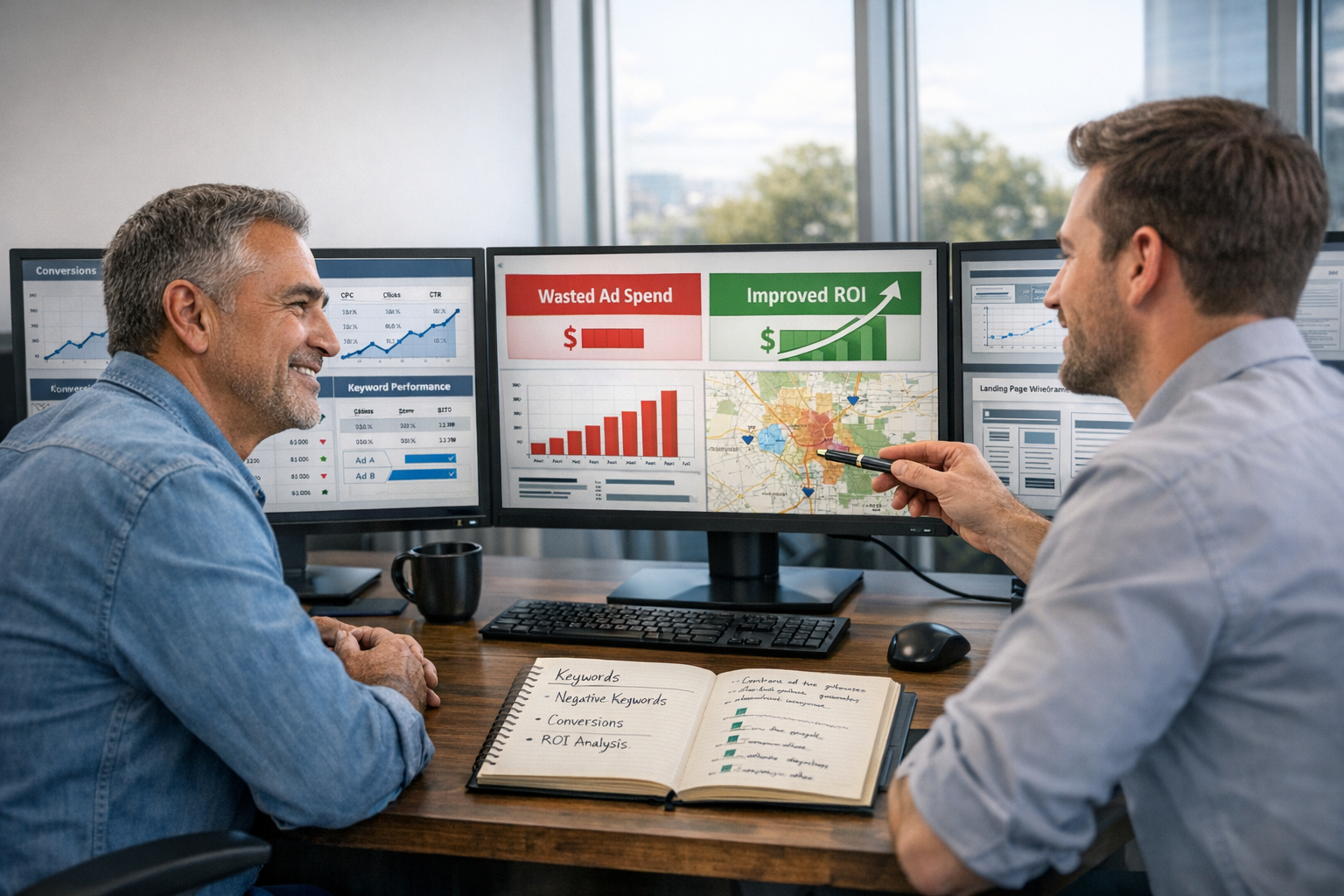
PPC advertising for small businesses is not about spending more money. It is about spending smarter. When you combine the right PPC campaign strategy with disciplined PPC management, precise keyword targeting, optimized landing pages, compelling ad copy, and rigorous PPC tracking and analytics, the results speak for themselves.
We have helped businesses across Waco TX transform their pay-per-click (PPC) marketing from a frustrating cost center into a predictable lead generation system. Whether you are running Google Ads PPC, Facebook Ads, remarketing campaigns, or a combination of all three, the principles are the same. Define your goals, target the right audience, optimize every touchpoint, and measure everything.
Small business digital marketing does not have to be overwhelming, and online advertising does not have to feel like throwing money into the wind. With the right local marketing services partner, pay-per-click advertising becomes one of the most transparent, measurable, and profitable investments your business can make.
If you are ready to stop wasting ad spend and start seeing real results from your PPC campaigns, we would love to talk. Our team at Sith Marketing specializes in local PPC advertising and lead generation for businesses right here in Waco TX. Visit us at https://sithmarketing.com to schedule a free consultation and find out exactly how we can help your business grow.




Leave A Comment